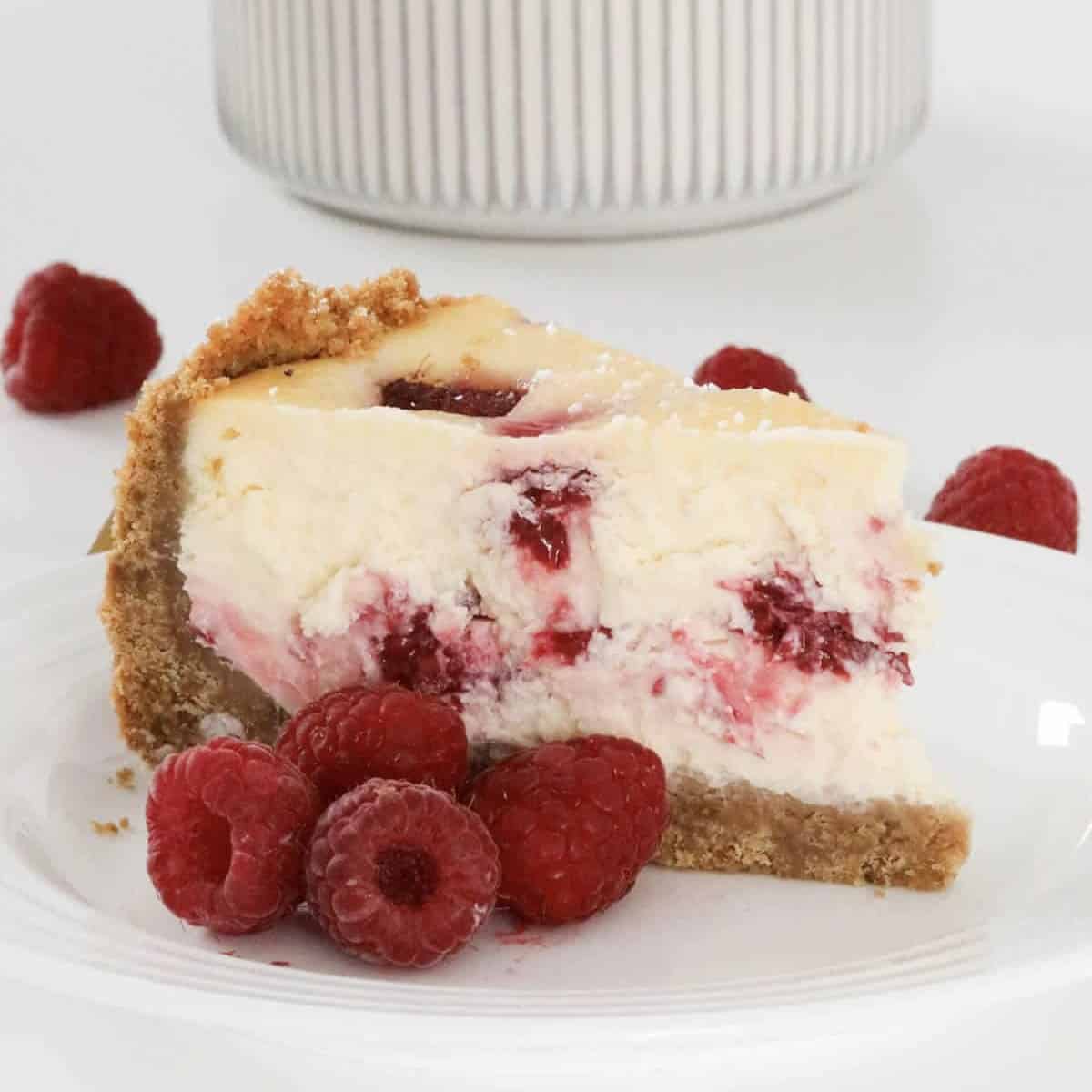
Raspberry Baked Cheesecake
A restaurant quality rich and creamy Raspberry Baked Cheesecake recipe! The ultimate show-stopping dessert.
Print
Pin
Servings: 16 serves
Calories: 498kcal
Cost: $15
Equipment
- Food processor
- Beaters or Thermomix
- Oven
Ingredients
- 375 g plain sweet biscuits crushed, like Arnott's Nice or Marie biscuits or Graham Crackers
- 250 g unsalted butter melted
- 750 g full fat cream cheese room temp
- 215 g (1 cup) caster sugar
- ½ teaspoon vanilla extract or vanilla essence
- 2 teaspoons finely grated lemon rind
- 1 teaspoon lemon juice
- 2 tablespoons plain flour
- 4 eggs room temp
- 300 ml full fat sour cream room temp
- 250 g fresh raspberries
- 2 tb sifted icing sugar (optional)
Instructions
Conventional Method
- Preheat oven to 140 degrees celsius (fan forced) or 285 degrees fahrenheit. If using a conventional oven, then 160 degrees celsius or 320 degrees fahrenheit.
- Grease and then line the base and sides of a 23cm springform pan with non-stick baking paper (see recipe tips below).
- Finely crush the biscuits in a food processor and then place into a large bowl.
- Add the melted butter and mix thoroughly until well combined.
- Spoon half of the biscuit crumbs onto the base of the prepared tin. Use a glass to press the mixture down evenly (you will also need to use a spoon to press the edges down firmly).
- Press the remaining half of the mixture firmly up the sides of the pan (leaving a small 1cm gap near the top).
- Chill in the fridge for 30 minutes.
- Beat the cream cheese, sugar, vanilla, lemon juice and lemon rind with electric beaters until just combined (don't over-beat).
- Gently beat in the flour followed by the eggs (1 at a time). Beat until just combined.
- Stir through the sour cream until combined.Gently fold half of the fresh raspberries through (reserve the other half for decorating).
- Gently pour the cheesecake mixture into the base of the tin.Press a couple of extra fresh raspberries on top.
- Place the the tin onto a baking tray and bake for 1 ¼ hours or until just set in the centre. Do NOT open the oven during the cooking time or the cheesecake will crack and sink (see recipe tips below).
- Turn the oven off and leave the cheesecake in the oven with the door closed for 2 hours.
- Place the cheesecake onto the bench until completely cooled before placing into the fridge (still in the baking tin).
- After a minimum of 4 hours in the fridge (preferably overnight), carefully remove the cheesecake from the baking tin and remove the baking paper.
- Allow to come to room temperature for 1 hour before serving and then top with remaining fresh raspberries and sift over the icing sugar (optional).
Thermomix Method
- Preheat oven to 140 degrees celsius (fan forced) or 285 degrees fahrenheit. If using a conventional oven, then 160 degrees celsius or 320 degrees fahrenheit.
- Grease and then line the base and sides of a 23cm springform pan with non-stick baking paper (see recipe tips below).
- Place the butter (chopped) into the Thermomix bowl and melt for 3 minutes, 80 degrees, Speed 2 (or until melted).
- Add the biscuits and mix for 10 seconds on Speed 8, or until completely combined.
- Spoon half of the biscuit crumbs onto the base of the prepared tin. Use a glass to press the mixture down evenly (you will also need to use a spoon to press the edges down firmly).
- Press the remaining half of the mixture firmly up the sides of the pan (leaving a small 1cm gap near the top).
- Chill in the fridge for 30 minutes.
- In a clean and dry Thermomix bowl, set the Thermomix to 37 degrees, 25 minutes, Speed 3. Note: it will NOT take 25 minutes, but by setting the timer for this long will keep it at the right temperature while you add in the other ingredients). With the blades turning, place the cream cheese into the Thermomix bowl and mix until well combined.
- Slowly add in the caster sugar, followed by the flour and eggs and mix until just combined.
- Place the butterfly attachment into the bowl (with the cream cheese mixture in it). Still on Speed 3 slowly add in the grated lemon rind, lemon juice, vanilla extract and sour cream. Scrape down the sides of the bowl and mix until completely smooth (don't over mix).Gently fold half of the fresh raspberries through with the spatula (reserve the other half for decorating).
- Gently pour the cheesecake mixture into the base of the tin.Press a couple of extra fresh raspberries on top.
- Place the the tin onto a baking tray and bake for 1 ¼ hours or until just set in the centre. Do NOT open the oven during the cooking time or the cheesecake will crack and sink (see recipe tips below).
- Turn the oven off and leave the cheesecake in the oven with the door closed for 2 hours.
- Place the cheesecake onto the bench until completely cooled before placing into the fridge (still in the baking tin).
- After a minimum of 4 hours in the fridge (preferably overnight), carefully remove the cheesecake from the baking tin and remove the baking paper.
- Allow to come to room temperature for 1 hour before serving and then top with the remaining fresh raspberries and sift over the icing sugar (optional).
Notes
FOR THE PERFECT BAKED CHEESECAKE:
INGREDIENTS:
- Types of cookies/biscuits to use - you can use any type of plain sweet cookies for the base.
- Use full-fat ingredients - for the ultimate rich and creamy texture, use full-fat cream cheese and sour cream. Light versions just won't give the same results unfortunately!
- Use room temperature ingredients - again, for best results, make sure all of your ingredients are at room temperature before mixing (cream cheese, eggs and sour cream). This helps the ingredients to combine more easily, and starts the baking process as soon as the cheesecake is placed in the oven.
- Choose fresh, not frozen, raspberries for this baked cheescake.
- Grease and line a springform pan - the best way to prepare your springform pan is by removing the bottom tray, greasing it, placing a sheet of baking paper over the top and then securing it with the clasps. This makes moving the cheesecake onto a serving dish much easier. Ensure that you also grease and line the sides of the pan with baking paper too.
- Preparing the base and sides- use a round, flat glass to press the mixture down as firmly as you can on the base of the springform pan. Use the back of a spoon to press the crumbs on to the sides. Chill the base in the fridge for at least 30 minutes.
- Don't over-beat the mixture - over-beating will cause the cheesecake to crack when cooking. Mix with hand-held beaters or a stand-mixer on medium/low speed. You don't want to get too much air into your cheesecake mixture as it's meant to be dense and firm when baked, so mix ingredients until just combined.
- Place the springform tin onto a baking tray - this will avoid any spills when cooking. Because the cheesecake is baked in a springform pan, some of the butter from the cookie base may escape through the small cracks - your baking tray will be there to catch any drips!
- Add a pan of water to the oven when baking - you can place a tray of water in the oven on the lowest shelf and place the cheesecake on the middle shelf (optional). The added moisture also helps to prevent your cheesecake from cracking.
- Bake the cheesecake low and slow - make sure your oven isn't too hot - an oven that is too hot may cause the cheesecake to crack. Keep in mind that oven temperatures can vary, so if you think yours runs a little hot, turn it down slightly before baking.
- Do NOT open the oven - opening the door when the cheesecake is cooking will change the temperature and can cause the cheesecake to sink and crack.
- Leave the cheesecake in the oven after baking - once the cooking time has finished, still do NOT open the oven door! Leave the door closed (with the oven turned off) for at least 2 hours, again, this will help to prevent the cheesecake from cracking.
- How to know if the cheesecake is cooked (without opening the oven door) - it's very important NOT to open the oven door during and after cooking which means that you can't physically check that the cheesecake is cooked. Firstly, trust that if you follow the recipe (and your oven temperature is correct), 1 hour and 15 minutes is enough to cook the cheesecake through. The cheesecake will continue to cook and set as it slowly cools in the oven over the next 2 hours. You don't want to overcook it!
- Chilling the cheesecake - when you remove the cheesecake from the oven (at least 2 hours after the cooking time has finished), leave it on the bench until it has cooled completely, and then place into the fridge (STILL in the baking pan) for a minimum of 4 hours (preferably overnight).
- Storing - wrap cheesecake in plastic wrap and place into an airtight container in the fridge for up to 5 days. It can also be frozen for up to 1 month.
- Serving - baked cheesecakes are best served at room temperature. Remove from the fridge 1 hour before slicing and serving. If decorating, do so immediately prior to serving.
- Serving suggestions - I love to serve this Baked Raspberry Cheesecake with fresh raspberries and dusted with icing sugar, however some other suggestions include a drizzle of lemon curd, a berry coulis, whipped cream, finely grated lemon zest, or fresh mixed berries (strawberries, blackberries, blueberries and raspberries).
Nutrition
Calories: 498kcal | Carbohydrates: 33g | Protein: 6g | Fat: 39g | Saturated Fat: 21g | Cholesterol: 140mg | Sodium: 298mg | Potassium: 138mg | Fiber: 1g | Sugar: 21g | Vitamin A: 1220IU | Vitamin C: 1.4mg | Calcium: 84mg | Iron: 1.1mg
