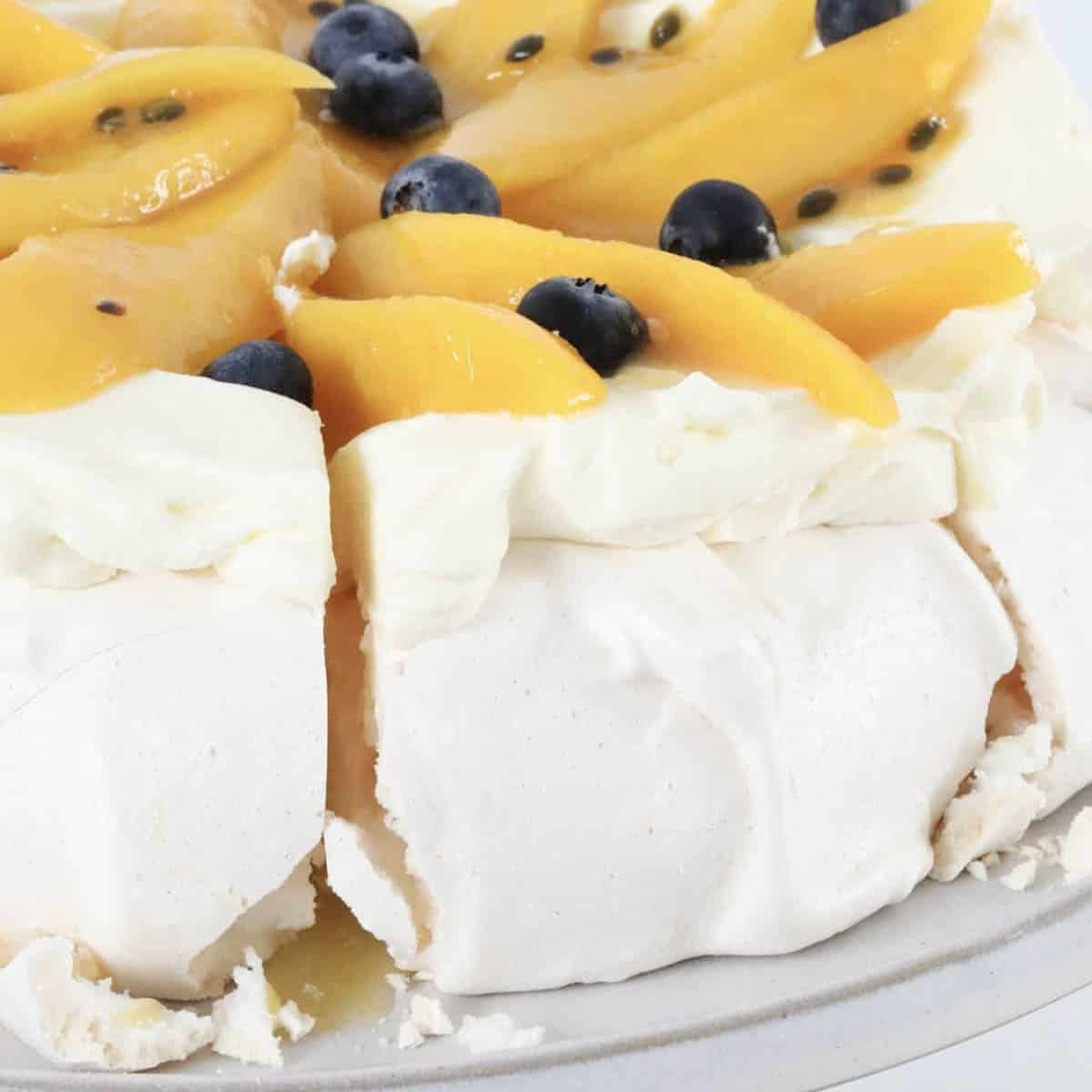
Passionfruit Mango Pavlova
A simple, step-by-step Passionfruit Mango Pavlova recipe! Perfect for Christmas and summer BBQs!
Print
Pin
Servings: 16 serves
Calories: 143kcal
Cost: $10
Equipment
- Oven
- Beaters, stand-mixer or Thermomix
Ingredients
For The Pavlova
- 6 egg whites room temperature
- 275 g (1 ¼ cups) caster sugar
- 1 tbs cornflour
- 1 teaspoon white vinegar
- 1 teaspoon vanilla extract
For The Cream
- 300 ml thickened cream
- 15 g (1 tbs) caster sugar
- 1 teaspoon vanilla extract
For Decorating
- mango slices
- passionfruit pulp
Instructions
- Preheat oven to 150 degrees celsius (fan-forced).
- Line a large flat baking tray with baking paper. Use a round 23cm cake tin to draw a circle onto the baking paper (this will be your guide for the pavlova mixture). Set aside.
- Place the egg whites into a large, clean and dry mixing bowl. Beat using hand-held beaters or a stand-mixer until soft peaks have formed. If using a Thermomix: Insert the Butterfly and add the egg whites. Whisk for 3 minutes, 37 degrees, Speed 3.5 (MC removed).
- Add the caster sugar, 1 tablespoon at a time, beating well between each addition. Continue beating until the mixture is very thick, glossy and no granules of sugar remain. If using a Thermomix: Set the Thermomix to mix for 4 minutes, Speed 3. Add 1 tbs of caster sugar at a time through the MC hole.
- Add the cornflour, white vinegar and vanilla extract and beat to combine. If using a Thermomix: Add the cornflour, white vinegar and vanilla extract and mix for 20 seconds, Speed 3 (MC removed).
- Spread the mixture onto the prepared tray, using a spatula to move the mixture to the edges of the circle. Use the spatula to shape the mixture into a dome-like shape with slightly higher edges. Use the spatula to flatten the top.
- Reduce oven temp to 100 degrees celsius (fan forced). Place the pavlova into the oven for 1 hr and 30 minutes. DO NOT OPEN THE OVEN DOOR AT ANY STAGE!
- Turn the oven off and leave the door closed until the pavlova is completely cold (overnight is best).DO NOT OPEN THE OVEN DOOR DURING COOKING OR COOLING! Doing so, will cause the pavlova to collapse.
- Store the pavlova in an airtight container at room temperature until ready to decorate and serve.
- To make the whipped cream, place the cream, caster sugar and vanilla extract into a large mixing bowl and whip until firm peaks have formed. If using a Thermomix: Place the butterfly into the Thermomix. Pour in the cream, caster sugar and vanilla extract and mix on Speed 3 until whipped to your liking (keep an eye on it and stop mixing as soon as the cream is whipped).
- Gently spread the whipped cream over the top of the pavlova.
- Decorate with fresh or tinned mango slices and passionfruit pulp.
Notes
RECIPE NOTES & TIPS
- Use room-temperature egg whites — they whip higher and more easily than cold ones.
- Make sure your bowl and beaters are spotless — any grease or moisture will prevent your meringue from whipping properly.
- Add the sugar slowly — one spoonful at a time — to avoid gritty texture and to help create a stable, glossy meringue.
- Bake low and slow — the lower temperature keeps the pavlova white, crisp on the outside, and soft in the centre.
- DO NOT OPEN THE OVEN DOOR during baking or cooling — the sudden change in temperature can cause the pavlova to crack or collapse.
- Decorate just before serving to keep the meringue crisp; cream and fruit will soften it over time. If using frozen mango or passionfruit pulp, ensure excess juice is drained so your pavlova topping doesn’t become soggy.
- Storage (undecorated): Store the cooled pavlova base in an airtight container at room temperature for 1–2 days.
- Freezing: You can freeze the undecorated pavlova base in an airtight container for up to 1 month. Do not freeze once it’s topped with cream or fruit.
Nutrition
Calories: 143kcal | Carbohydrates: 19g | Protein: 2g | Fat: 7g | Saturated Fat: 4g | Polyunsaturated Fat: 0.3g | Monounsaturated Fat: 2g | Cholesterol: 21mg | Sodium: 24mg | Potassium: 37mg | Fiber: 0.004g | Sugar: 19g | Vitamin A: 277IU | Vitamin C: 0.1mg | Calcium: 14mg | Iron: 0.04mg
